
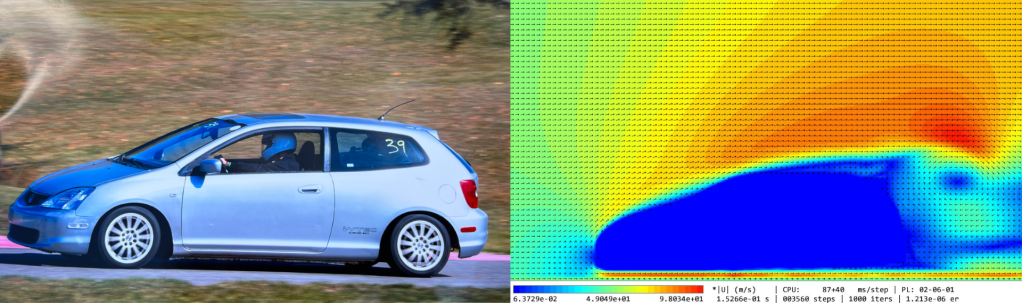
Lets talk aerodynamics!
Overview
I’m relatively new to automotive aerodynamics, with only a rudimentary understanding of aerodynamic concepts. My goal is to start my journey down this rabbit hole with my very own pride and joy, my 260,000-mile EP3 Civic!
The overall goal is to modify the car in a way that is based on improving track times, research, and hard data. Not just purchasing off-the-shelf parts, but rather marking and measuring improvements, why they occur, and where you could develop them in the future.
To begin, I wanted to learn the most basic piece of aerodynamic analysis: a two-dimensional air flow simulation!
Through reading the first few results on Google for Computational Fluid Dynamics (CFD) simulation software, I quickly learned that it would require something which I do not possess: money! My next path forward was to research CFD software which does not require money!
This research landed me on the home page of the wonderful software Flowsquare+.
The Software
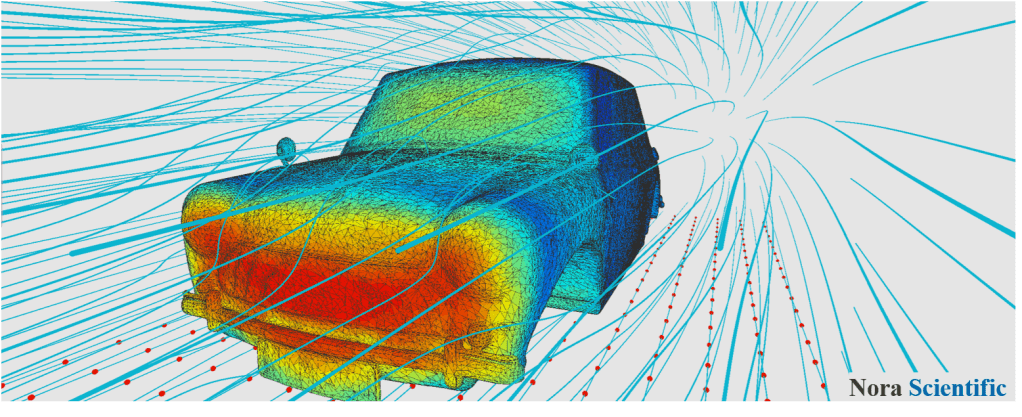
Flowsquare+! This software kicks butt, and its free! (You can read more about it or download it here)
I first discovered this through FULL TILT POTATO‘s video “Honda CRX Aero Modeling”. The video shows off a relatively simple 2D CFD simulation that seemed to present everything I was looking to learn: the basic aerodynamics of a car’s 2D shape!
In the description, he linked to the original version of Flowsquare, which brought me to learning about Flowsquare+, the latest revision of the software!
It’s a relatively simple suite of tools for performing both 2D and 3D CFD. Per their own website:
Flowsquare+ is a two- and three-dimensional computational fluid dynamics (CFD) software, which has a very handy and intuitive user interface which allows more users to perform their own simulations without too much cost and effort.
https://fsp.norasci.com/en/index.html
And best of all, the software is free!
Setting Up the Simulation
Lucky for us, one of the Flowsquare+ Tutorials entitled “Flow Around a Car (2D)” explains the process of importing a BMP of a car’s outline, setting up a 2D flow simulation within Flowsquare+, and exporting the results!
Before we continue, I highly recommend walking through the linked tutorial above.
To modify the tutorial simulation to fit the EP3 Civic, all we need to do is modify the car’s outline from a Mazda RX7 to the outline of an EP3 Civic!
We’re going to go through a few steps to add our own outline:
- Determine the size of the stage – this will help us size our vehicle to be realistic within the simulation!
- Find the size of the vehicle we’re creating an outline of
- Find a quality side-profile view of the vehicle we’d like to create an outline of
- Convert the photo into a black-and-white bitmap outline!
We’ll start with the first – stage sizing.
Stage Sizing
The hardest part about adding in our own vehicle outline is getting the sizing correct! To ensure we’re accurately sizing the outline, we’re going to need a few variables from the tutorial:
- 512×256 – The resolution of the bcXY0.bmp image
- lx – 9m – This is the length of the ‘stage’ in the X-direction
- ly – 4.5m – This is the length of the ‘stage’ in the Y-direction
Using this information, we can determine that 512px (the width of the stage) is equal to 9m in length. That means each meter is approximately 56.88px in length! This measurement will be handy in future steps for converting our car to the right size bitmap outline.
Finding the Vehicle’s Size
This step is relatively easy – you just need to Google it! Websites like Encycarpedia offer a number of stats about every vehicle under the sun, including the dimensions. While aftermarket modifications such as wings, bumpers, or body kits may change the overall measurements, the factory-standard measurements can be a great starting place to begin creating a model of your vehicle.
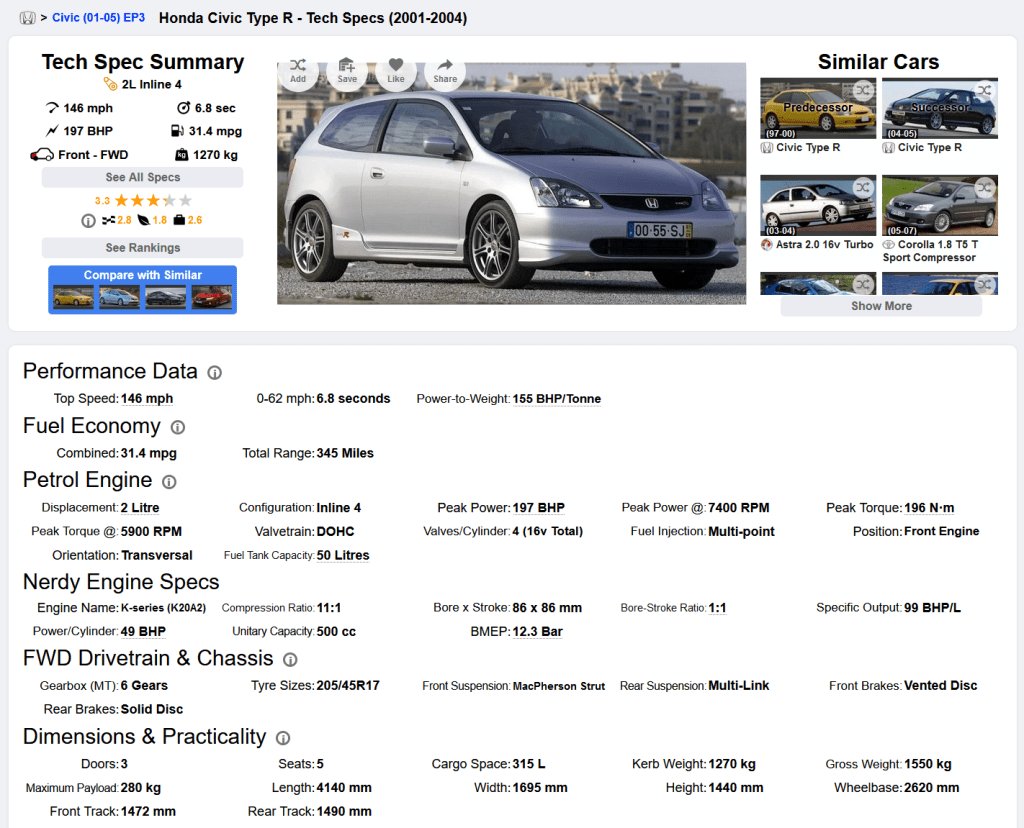
According to Encycarpedia, the overall length of a 2001-2004 Honda Civic Type-R is 4140mm. Exactly the information we need to know for our simulation!
If you would prefer a more official source than Google, or if websites like Encycarpedia are unavailable to you, information on your vehicle’s dimensions can also commonly be found in the owner’s manual.
Locating a Side Profile Photo
The next step is to find a photograph with a perfect side profile of the car. This is unfortunately harder than it sounds – even slight shifts in perspective can make the side profile extremely inaccurate, so taking some time to find the perfect photo is well worth the effort spent.
For this step, I simply searched “EP3 side shot photo” on Google Images:
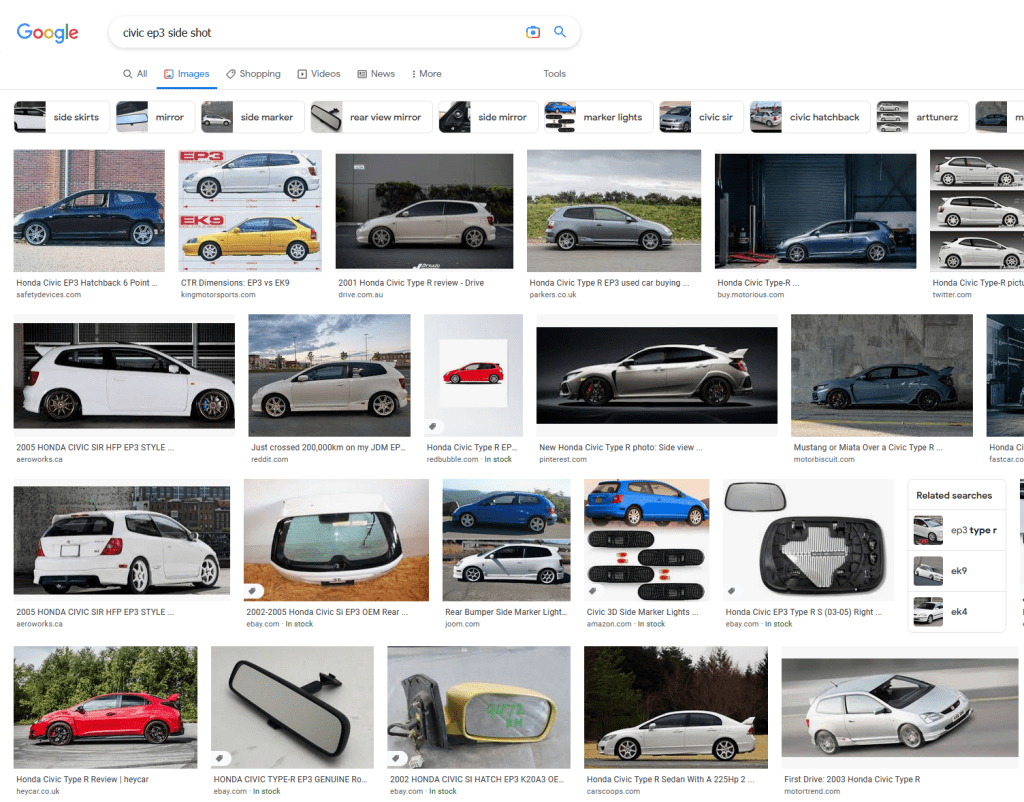
In the end, I settled on the below image:
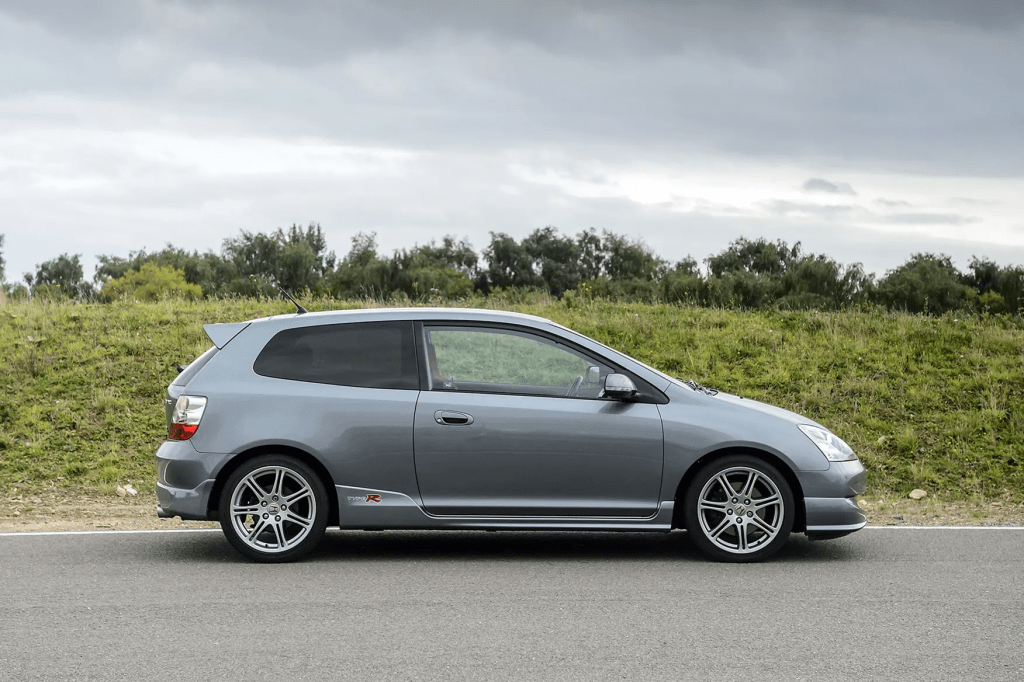
The professional course of action here would most likely be utilizing the 2D image generated by a proper 3D CAD model or 3D scan of a vehicle, however I don’t have access to that! For our purposes, reverse engineering the side profile using a photograph will be fine.
Converting the Photo into an Outline!
Now, we’re going to get into some cursed Photoshop wizardry (well, I’m actually going to be using GIMP, because I don’t have a Photoshop license).
The first part will be cutting out the car’s outline. For this, I used GIMP’s Free Select tool to trace the outline of the vehicle, leaving me with this!
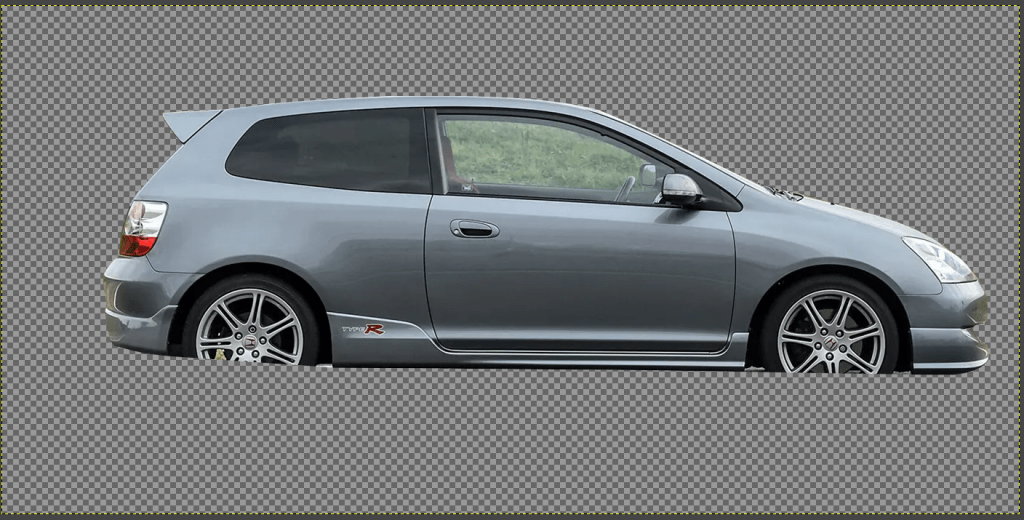
From here, we’ll flip it horizontally in order to mirror the direction of the demo outline (Image -> Transform -> Flip Horizontally), and work on filling it in completely with black.
To do this, we’ll use the Fuzzy Select tool to select the now-empty area around the car, and then click Select -> Invert in order to invert our selection, so that only the car’s outline is selected again!
From here, create a new layer, hide the layer with the actual car’s image, and use the paint bucket tool to fill the selection area in with black.
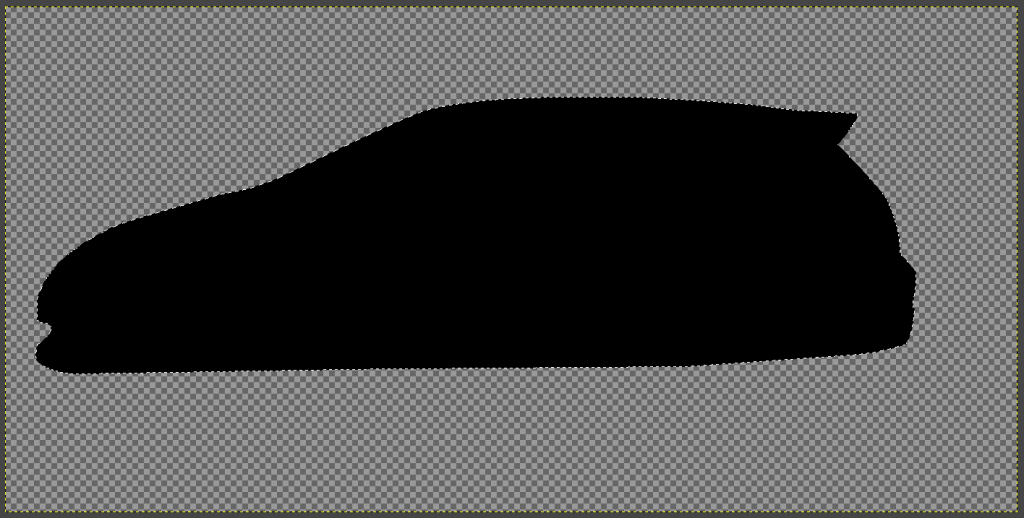
Huzzah, we have an outline! Now is where the hacky part comes into play…
With the outline’s selection still active, click on the Scale Tool and click on the outline – a box showing the outline’s current dimensions will pop up, as seen below:
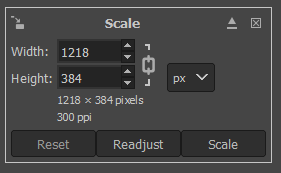
This is where we’ll be manipulating our images size! Remember those values we researched earlier? This is where those come into play.
From our research, we discovered the EP3 Civic should be 4140mm in length. Additionally, in the 512×256 resolution that the simulation uses, 1m = 56.88px. So, to extrapolate:
4140mm == 4.14m. If 1m = 56.88px, our vehicle’s pixel size should be 4.14 * 56.88px, which equals 235.4832px. We’ll round this to 236px to make things somewhat easier in GIMP.
So, with a total length of 236px, it’s time to resize our image! In the scale box, ensure that the width and height values are locked to stay in ratio to each other (the ‘chain’ symbol between the two numbers), and enter 236px for the width.
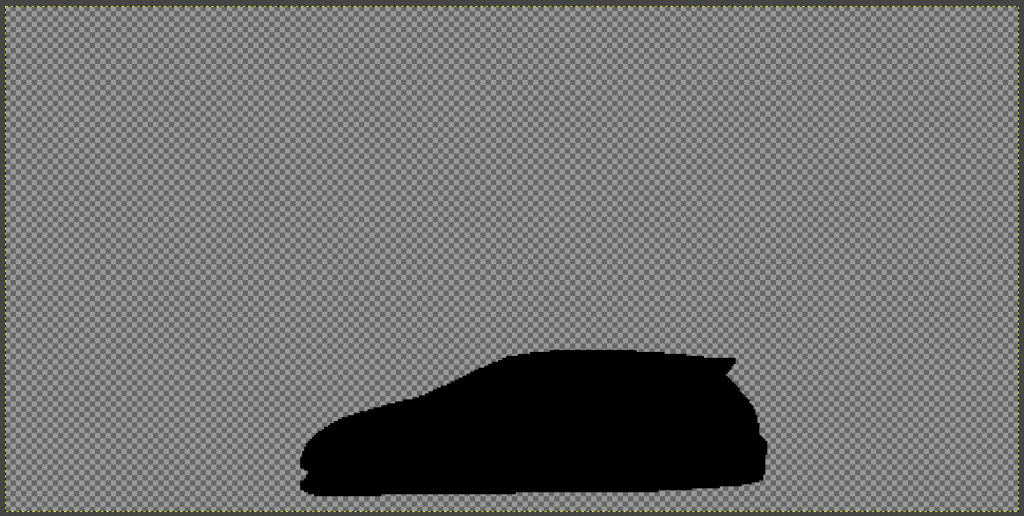
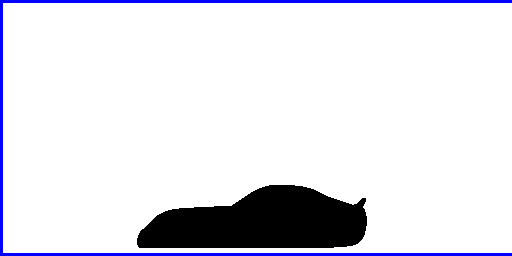
Congrats, our outline is now properly sized for the stage! Now is also a good time to resize your overall canvas to 512×256, if you haven’t yet.
From here, the final step is to create the overall background and boundaries that Flowsquare+ recognizes. The background is easy – simply create a new layer and paint bucket the entire thing white!
As for the boundaries, I created mine to be exactly 3px wide, which seemed to work well. The easiest way to do this is to create a new layer, select the entire canvas (Ctrl+A), and then click Select -> Shrink… -> 3px, and then Select -> Invert. Now, use the paint bucket to fill this new selection area with pure blue! (Hex Code: 0000ff) Finally, you’ll have to delete the furthest right side of the border in order to give the air somewhere to exit. I did this by selecting it free-hand with the rectangle select tool and hitting Delete.
Once you’re all said and done, it should look something like this!
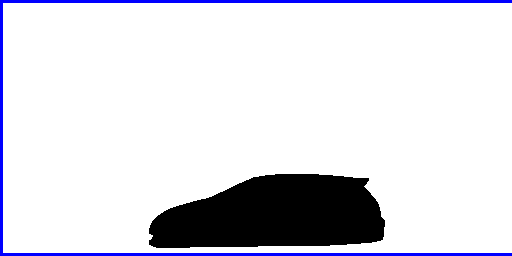
The image above is actually my properly-sized EP3 .bmp image – feel free to download it if you’d like to use it in your own simulations!
Bringing it All Into Flowsquare+
The final step before we run our simulation is to actually bring our new outline bitmap into Flowsquare+!
Doing this is as simple as swapping out the image file in the RX7-based tutorial, while maintaining the values of each of the variables that are set.
First, rename your new vehicle outline to match the title of the RX7 outline – ‘bcXY0.bmp’. Next, back up the RX7 outline (optional) and copy your new outline in its place!
Then, simply open Flowsquare+ and open the project, by selecting the associated project param.txt file.
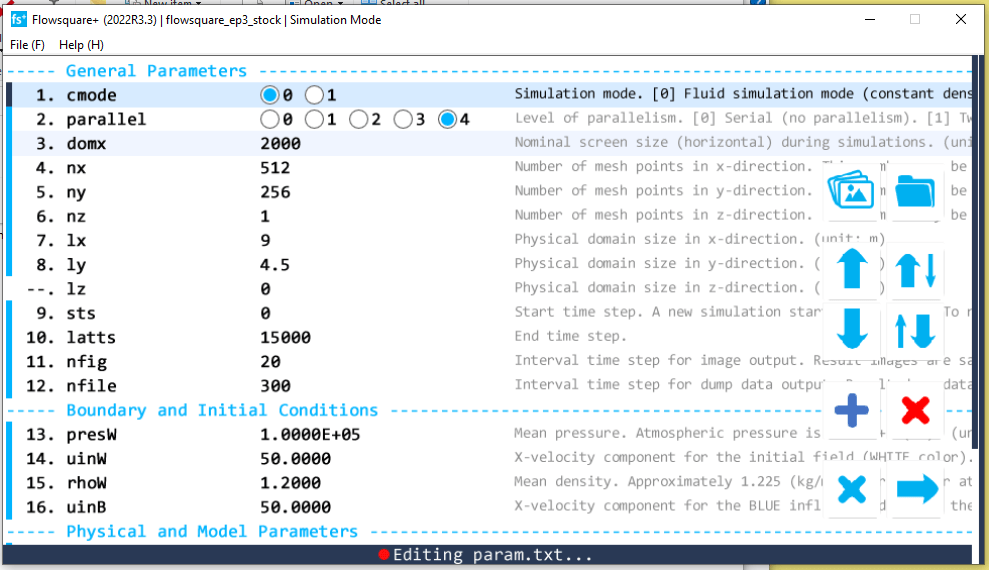
Above are the default tutorial simulation variable settings, and they’re what I used for this sim! The only options I would recommend changing are in relation to the simulation length and image saving options – I modified the ‘latts’ variable to equal 15,000 (the total number of steps), and ‘nfig’ to equal 20 – the interval at which screenshots should be taken. This isn’t necessary unless you’re looking to render a video of your results!
I render my videos at 60fps, so 20 steps per frame @ 60fps == 1200 steps per second overall. Why this speed? Well, mainly because it’s the speed at which the Nora Scientific demonstration video was rendered at on YouTube – I just copied them.
The Final Product!
Below is my actual rendered EP3 Civic simulation.
And with that, we’re done!! I’m sure there’s a ton to expand on and learn from – ways to improve the simulation, ways to simulate spoilers, wings, and different air speeds, and you could probably write a whole bible on how to interpret the results.
But that’s not what we’re here for – today, we got a basic sim working! In future blog posts we’ll dive further into the data, an analysis of it, and where to proceed from here.
Thanks for reading! If you have any feedback or comments, feel free to leave them below or reach out.
 Every Medium
Leave a comment